
If You Do the Crime, You Do the Time: Ultra-Processed Food on Trial

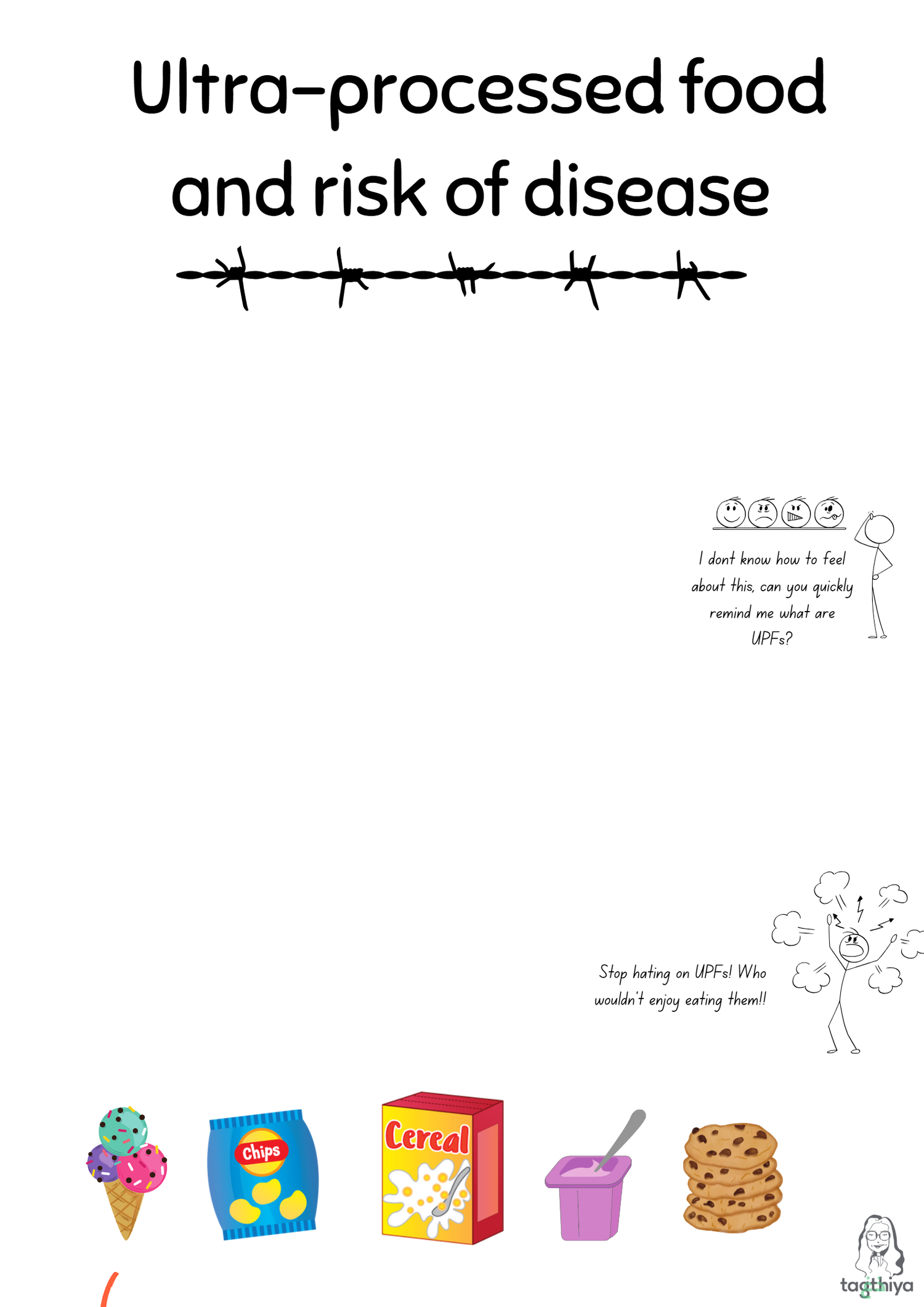
Ultra-processed food and risk of disease
While individuals may face legal or social consequences for their actions ("do the time"), food industries responsible for the production and widespread distribution of Ultra-Processed Food (UPF) appear to operate with relatively little oversight or consequence.
UPF
They are commercially manufactured food products made mostly from low-cost raw materials which are also processed such as hydrogenated fats, added sugars and salts etc. They are typically unhealthy and nutrient-poor ingredients rich in sugar, salt, trans-fats, and food additives and preservatives. UPFs are hyper-palatable, have a higher shelf life, more affordable, and are heavily marketed to consumers, particularly children and adolescents.
UPFs examples:

The data we have been waiting for:
A recent extensive study involving over 1.1 million participants
Consumption of UPFs and an increased risk of cardiovascular diseases (CVDs).
Strong link between
In other words,
There’s a positive linear relationship between UPF intake and risk of cardiovascular events- the higher the intake, the higher the risk
Particularly, for every 10% increase in the consumption of ultra-processed foods by daily weight, there's a 1.9% rise in the risk of cardiovascular events .
linked to more than 30 illnesses such as heart disease, high blood pressure, anxiety, diabetes type 2, and cancers

& there’s more to it ...
Another recent study showed that a 5% increase in UPF intake, increases deaths caused by chronic obstructive pulmonary disease by 17%
A lung disease that causes obstructed airflow from the lungs
Additionally, there has been a remarkable decrease in semen quality over the last decades in industrialized countries. This has been linked to UPF consumption.
There was an association between higher UPF consumption and lower total sperm count, concentration and motility

“Ta ذغ iya” by Sarah Zahr
These connections emphasize the critical need for public health policies to limit the intake of these foods, considering their growing presence in diets worldwide.
Mekonnen, T. C., Melaku, Y. A., Shi, Z., & Gill, T. K. (2024). Ultra-processed food consumption and risk of chronic respiratory diseases mortality among adults: evidence from a prospective cohort study. European Journal of Nutrition, 1-16.
Qu, Y., Hu, W., Huang, J., Tan, B., Ma, F., Xing, C., & Yuan, L. (2024). Ultra-processed food consumption and risk of cardiovascular events: a systematic review and dose-response meta-analysis. Eclinicalmedicine, 69.
Valle-Hita, C., Salas-Huetos, A., Fernández de la Puente, M., Martínez, M. Á., Canudas, S., Palau-Galindo, A., ... & Babio, N. (2024). Ultra-processed food consumption and semen quality parameters in the Led-Fertyl study. Human Reproduction Open, 2024(1), hoae001.